Polymers
Long-chain molecules — thermoplastics, thermosets and elastomers — why plastics are light and flexible, and how temperature changes them.
0 deeper section(s) hidden.
On this page
The idea
A is made of very long chain molecules built from repeating units. How the chains are joined decides the type: can be melted and reshaped, are cross-linked and never melt again, and stretch a long way and spring back. Polymers are light and easy to shape, but much less stiff than metals, and their properties change a great deal with temperature around the .
Everyday intuition
A plastic carrier bag stretches and slowly creeps under a heavy load. A ruler left in a hot car sags. Epoxy glue sets hard and stays hard until it chars. A rubber band stretches several times its length and snaps back.
How it works
- Chains. Small molecules (monomers) join into long chains. Bonds along a chain are strong; forces between chains are weak, so polymers deform mainly by chains sliding and uncoiling.
- Branches, cross-links and crystallinity decide the type and the stiffness, as the adapted text below explains.
- Creep. Under steady load, polymers keep deforming slowly even at room temperature, so long-term designs use lower stresses.
In more detail
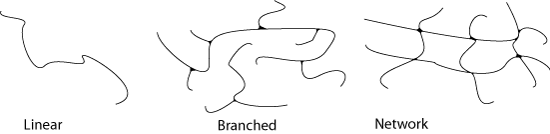
Individual chains can be linked together to produce a branched structure or a network.
Cross-links
Whereas branching involves joining the head of one chain to a point in the middle of another, cross-linking joins two chains together at some point along their length. Cross-linking in a polymer forms a network structure. A network is in fact one giant molecule because the cross-links are primary chemical bonds.
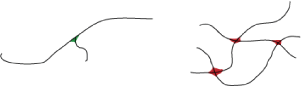
Without cross-links, van der Waals forces hold adjacent molecules together. These are weak attractions, caused by the interaction of electrons. They break easily on heating, allowing the molecules to slide past each other. Substances made from un-cross-linked polymers are therefore able to melt, and are called thermoplastics.
Cross-links are primary chemical bonds, which require much more energy to break than van der Waals forces. When a polymer of this type is heated, the covalent cross-links prevent individual molecules from sliding past one another, so melting does not occur. This type of polymer is called a thermoset. At a sufficiently high temperature, the covalent bonds both in the cross-links and within the molecules are broken, and the thermoset decomposes.
A polymer with only a small degree of cross-linking is an elastomer. The cross-links are infrequent enough to allow significant conformation changes in the chains between cross-links, while still preventing individual molecules from flowing past each other. Elastomers can accommodate a large amount of recoverable deformation, behaviour typical of rubber. Much more information about the behaviour of elastomers is available in the Stiffness of Rubber TLP.
Cross-links may be added after synthesis by a separate process. One such process is vulcanisation, where cross-links are added to rubber by heating it with sulphur.
Crystallinity defines the degree of long-range order in a material, and strongly affects its properties. The more crystalline a polymer, the more regularly aligned its chains. Increasing the degree of crystallinity increases hardness and density. This is illustrated in poly(ethene).
HDPE (high density poly(ethene)) is composed of linear chains with little branching. Molecules pack closely together, leading to a high degree of order. This makes it stiff and dense, and it is used for milk bottles and drainpipes.
The numerous short branches in LDPE (low density poly(ethene)) interfere with the close packing of molecules, so they cannot form an ordered structure. The lower density and stiffness make it suitable for use in films such as plastic carrier bags and food wrapping.
Each polymer has its own glass transition temperature, Tg. Below Tg it is hard and glassy; above Tg the chains can move and it becomes rubbery. Many polymers are above Tg at room temperature, and many are partly crystalline, with crystals that melt at a higher temperature, Tm.
Elastomer: few cross-links, so chains uncoil when stretched and recoil when released.
Key formulas
Equal bending stiffness (rectangular beam, same width):
- Young’s modulus Pa
- second moment of area m⁴
- width m
- depth m
Worked example
Where it is used
- Packaging, pipes and containers (polyethylene, PVC, PET).
- Quiet gears and bearings without oil (nylon, acetal).
- Adhesives and composite matrices (epoxy thermosets).
- Seals, tyres, hoses and vibration mounts (elastomers).
Common misconceptions
Self-check
Check A plastic coat hook slowly bends further over months. What is happening?
Show answer
Creep: the chains slowly slide and uncoil under constant load.
Check Why can a thermoplastic bottle be remelted but cured epoxy cannot?
Show answer
The thermoplastic’s chains are separate; epoxy’s are cross-linked into one network.
Check What happens to a polymer used above its glass transition temperature?
Show answer
It changes from hard and glassy to soft and rubbery; stiffness can drop by a hundred times or more.
My notes
Private to this browser. Select any text above to highlight it.