Composites
Combining stiff fibres with a tough matrix — glass and carbon fibre composites, the rule of mixtures, and why direction matters.
0 deeper section(s) hidden.
On this page
The idea
A combines two or more materials so the mix outperforms either alone. The most important engineering composites put strong, stiff fibres (glass, carbon, aramid) inside a polymer . The fibres carry the load; the matrix holds them in place and passes load between them. Composites can be very stiff and strong per kilogram, but only along the fibres: they are , so designers lay fibres in the directions the loads act.
Everyday intuition
Wood is a natural composite: cellulose fibres in a softer matrix. It splits easily along the grain but resists breaking across it. A carbon-fibre bicycle frame is light and stiff because the fibres are laid exactly where the loads run.
How it works
- Thin fibres are strong because they contain few flaws.
- Along the fibres fibre and matrix stretch together, so the stiff fibres take most of the load (the rule of mixtures).
- Across the fibres the soft matrix carries load in series with the fibres, so stiffness and strength are much lower.
- Laminates stack thin plies at different angles (0°, ±45°, 90°) to suit the loads.
- Weak points: delamination between plies, hidden impact damage, holes and joints, and difficult recycling.
In more detail
Generally, a composite is a combination of two materials that exhibit desired properties of both constituents, such as compressive strength of the matrix and tensile strength of the fibres. Usually, they consist of ceramic or polymer fibres embedded in a matrix, usually a thermosetting resin such as an epoxy or polyester, but can also be thermoplastics or ceramics or even metals. The fibres are strong due to the removal of flaws in the case of ceramics and molecular alignment for polymers. The three main types of fibre used are:
-
Glass
-
Carbon
-
Aramid (aromatic polyamides, such as Kevlar ).
In some types of composite, the fibres are oriented randomly within a plane, while in others the material is made up of a stack of differently-oriented “plies” to form a laminate, each ply containing an aligned set of parallel fibres.
The axial and transverse Young’s Moduli can be predicted using a simple slab model, in which the fibre and matrix are represented by parallel slabs of material, with thicknesses in proportion to their volume fractions, E and (1- E).
Axial Loading: Voigt model
The fibre strain is equal to the matrix strain: EQUAL STRAIN.
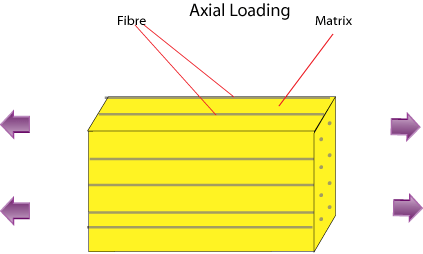
Loading across the fibres: the matrix carries the load, low stiffness.
Key formulas
Rule of mixtures, along the fibres:
Rule of mixtures, across the fibres:
Density of a composite:
- composite modulus along the fibres Pa (GPa)
- fibre and matrix modulus Pa (GPa)
- fibre volume fraction none
- composite modulus across the fibres Pa (GPa)
- densities of composite, fibre and matrix kg/m³
Worked example
Where it is used
- Aircraft, wind-turbine blades, racing cars and bicycles (carbon and glass fibre).
- Boat hulls, pipes and tanks (glass fibre).
- Protective vests and helmets (aramid fibre).
- Reinforced concrete in buildings and bridges.
Common misconceptions
Self-check
Check Why are composite plies stacked at different angles?
Show answer
Each ply is stiff and strong only along its fibres; several directions cover all the load directions.
Check Carbon fibres (E = 230 GPa, illustrative) at 50% volume in a resin of E = 5 GPa. Estimate the stiffness along the fibres.
Show answer
GPa.
Check Why is wood easier to split along the grain than across it?
Show answer
Splitting along the grain only breaks the weaker matrix between the fibres, not the fibres themselves.
My notes
Private to this browser. Select any text above to highlight it.