Module 1 · Engineering mechanics
Torque and moments
The turning effect of a force — moment equals force times perpendicular distance — and how levers, spanners, couples and motors use it.
0 deeper section(s) hidden.
On this page
The idea
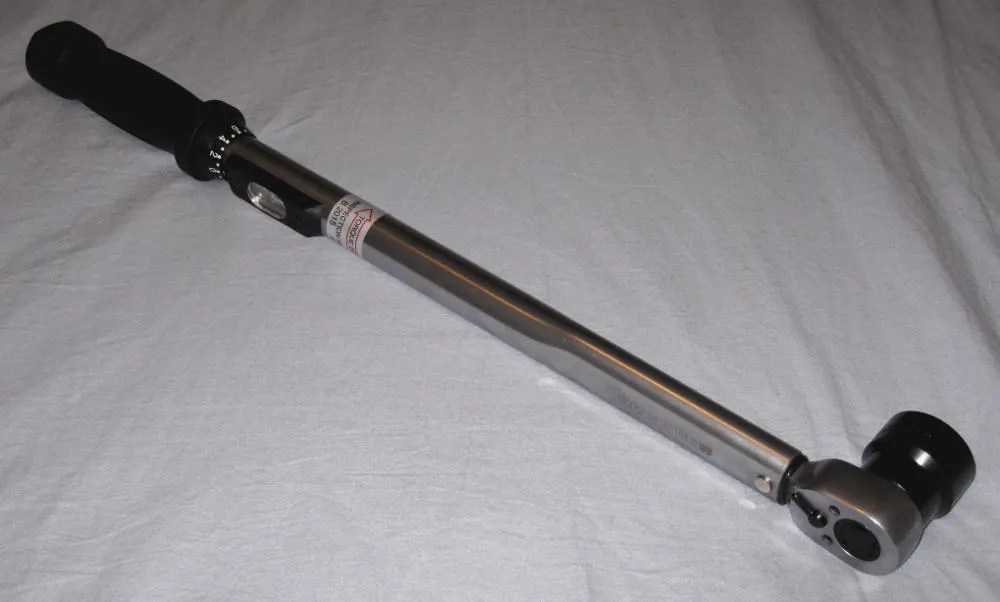
A force can make an object turn as well as move. Its turning effect about a point is the : force × perpendicular distance from the point to the line of the force, in newton-metres. When the turning effect comes from a shaft, motor or spanner, engineers usually call it . A longer lever arm gives more turning effect for the same force, which is why spanners have handles and doors have handles far from the hinges.
Everyday intuition
Try pushing a door open near its hinges: it is hard. Push at the handle and it swings easily. A wheel nut that will not shift with a short spanner often turns with a longer one. On a seesaw, a light child far from the middle can balance a heavy adult near the middle.
How it works
- Find the pivot. The point or axis about which turning happens (a hinge, a bolt centre, a shaft axis). For equilibrium calculations you may choose any point.
- Find the line of action of the force. Extend the force arrow into a line in both directions.
- Measure the perpendicular distance from the pivot to that line: the (moment arm).
- Multiply. Moment = force × lever arm. Give it a sense: clockwise or anticlockwise.
- Angled forces. If the force is at angle θ to the lever, only the component at right angles to the lever turns it: .
- Couples. Two equal and opposite forces whose lines are a distance d apart produce a pure turning effect, a , , with no net push. Turning a steering wheel with both hands applies a couple.
- Balance. For a body at rest, clockwise moments = anticlockwise moments about any point (equilibrium topic).
- Torque and power. A shaft carrying torque T at angular speed ω transmits power (Module 2).
Clockwise and anticlockwise moments are equal, so it balances.
Key formulas
Moment of a force about a point:
Couple and the balance of moments:
Mechanical advantage of a lever:
- moment or torque N·m
- force N
- perpendicular distance (lever arm) m
- distance from pivot to where the force acts m
- angle between the force and the line from pivot to the point of application °
Worked example
Where it is used
- Bolted joints: tightening torque sets bolt tension (Module 8).
- Engines and motors: torque at the shaft, and gearboxes to change it (Module 7).
- Cranes: load moment limits and counterweights.
- Levers, pliers, brakes and pedals: mechanical advantage.
- Structures: bending moments inside beams (Module 2) are internal moments.
- Robotics: joint torques needed to hold and move loads (Module 12).
Common misconceptions
Self-check
Check A bolt must be tightened to 40 N·m. With a 0.5 m wrench, what force at right angles to the handle is needed?
Show answer
N.
Check On a seesaw, a 300 N child sits 2 m from the pivot. Where must a 750 N adult sit to balance?
Show answer
, so m from the pivot on the other side.
Check Two hands push on a 0.4 m diameter steering wheel with 20 N each, in opposite directions at opposite sides of the rim. What is the torque?
Show answer
A couple: N·m.
My notes
Private to this browser. Select any text above to highlight it.