Crystal structure basics
How atoms pack in metals — unit cells, BCC and FCC, grains and dislocations — and why this explains ductility and strength.
0 deeper section(s) hidden.
On this page
The idea
In metals the atoms sit in a regular repeating pattern, a . The smallest repeating box is the . Most engineering metals use one of three patterns: , or . Real parts are made of many tiny crystals called , and line defects called let layers of atoms slip one row at a time — which is why metals bend instead of shattering.
Everyday intuition
Oranges stacked on a market stall settle into a tight, regular pattern: that is close packing. Moving a large rug by pushing a ripple along it, rather than dragging the whole rug, is how a dislocation lets a crystal deform with little force.
How it works
- Atoms as hard spheres. Metallic bonds are not directional, so metal atoms pack tightly, like marbles.
- Three common structures. BCC: iron at room temperature, chromium, tungsten. FCC: aluminium, copper, nickel, and iron above 912 °C. HCP: titanium, magnesium, zinc.
- Slip. Under shear, planes of atoms slide over each other. FCC metals have many easy slip planes, so they stay ductile even when very cold; some BCC steels turn brittle at low temperature.
- Strengthening means blocking dislocations. Grain boundaries, alloying atoms, fine particles and tangles of other dislocations all get in the way — every strengthening method in this module works like this.
In more detail
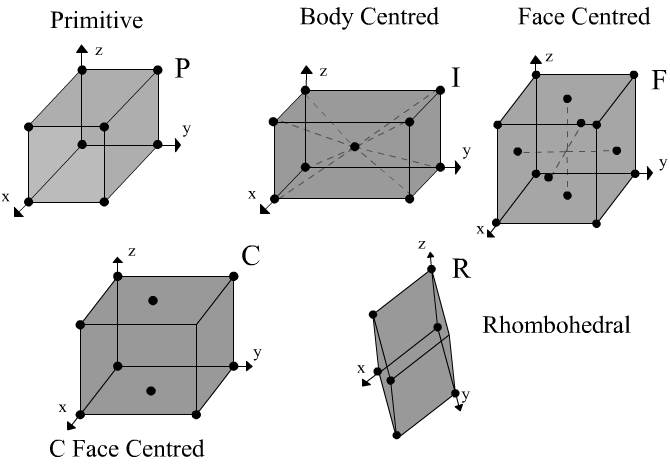
Atoms (lattice points) at the corners of a cell are shared by the eight cells that meet there, so each corner counts as ⅛. Points on an edge are shared by four cells (¼ each) and points on a face by two (½ each).
The most common types of unit cell are the primitive (P) unit cell with one lattice point per unit cell; the face centred (F) unit cell with additional lattice points at the centre of each face and four lattice points per unit cell; and the body centred (I) unit cell with a lattice point in the middle of the unit cell and two lattice points per unit cell. Other cell types are the C face centred unit cell and the rhombohedral unit cell.
In many cases the atoms of a crystal pack together as tightly as possible. Approximating atoms as hard spheres they will achieve this by forming a close-packed structure. This is the case for most metallic structures.
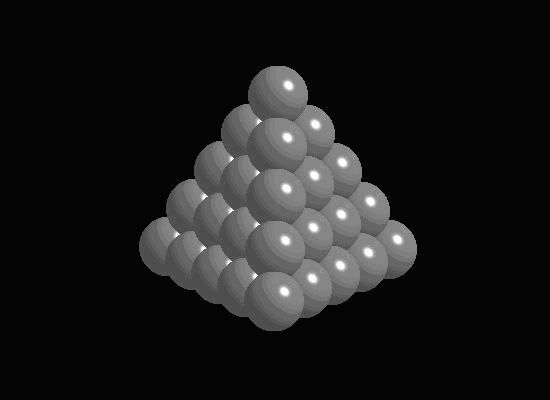
The packing efficiency of a crystal structure tells us how much of the available space is being occupied by atoms. It is usually represented by a percentage or volume fraction.
Single crystals form only in special conditions. The normal solid form of an element or compound is polycrystalline. As the name suggests, a polycrystalline solid or polycrystal is made up of many crystals. The properties of a polycrystal are notably different from those of a single crystal. The individual component crystallites are often referred to as grains and the junctions between these grains are known as grain boundaries.
The size of a grain varies according to the conditions under which it formed. Galvanised steel has a zinc coating with visibly large grains. Other materials have much finer grains, and require the use of optical microscopy.
The concept of the dislocation was invented independently by Orowan, Taylor and Polanyi in 1934 as a way of explaining two key observations about the plastic deformation of crystalline material:
-
The stress required to plastically deform a crystal is much less than the stress one calculates from considering a defect-free crystal structure
-
Materials work-harden: when a material has been plastically deformed it subsequently requires a greater stress to deform further.
Not until 1947 was the existence of dislocations experimentally verified. It took another ten years before electron microscopy techniques were advanced enough to show dislocations moving through a material.
FCC packs atoms more tightly and has more slip planes.
Key formulas
Atomic packing factor:
- atoms per unit cell none
- atomic radius m
- unit-cell edge length m
Worked example
Where it is used
- Low-temperature service: FCC metals such as aluminium and austenitic stainless steel are used for cryogenic tanks because they stay ductile.
- Grain refinement: controlled rolling and normalising give fine-grained, tougher steels.
- Single-crystal turbine blades remove grain boundaries entirely, which improves creep resistance at high temperature.
- X-ray diffraction identifies crystal structures and measures residual stress.
Common misconceptions
Self-check
Check How many atoms belong to one BCC unit cell?
Show answer
Eight corners × ⅛ = 1, plus one whole atom in the centre: 2 atoms.
Check Why do FCC metals like copper stay ductile at very low temperatures?
Show answer
They have many close-packed slip planes, so dislocations keep moving easily even when cold.
Check Name two ways to make dislocations harder to move.
Show answer
Any two of: smaller grains, alloying atoms in solid solution, fine hard particles (precipitates), cold working.
My notes
Private to this browser. Select any text above to highlight it.