Module 2 · Strength of materials
Strain and Hooke’s law
How much materials stretch under stress, the springy range where they bounce back, and the tensile test that maps their whole behaviour.
0 deeper section(s) hidden.
On this page
The idea
is how much something stretches compared with its original length. For many materials, small strains are springy and proportional to stress: double the stress, double the stretch. That is . Push past a limit and the material deforms permanently, then eventually breaks.
Everyday intuition
Pull a paper clip gently and let go: it springs back. That is behaviour. Bend it hard and it stays bent: that is . Bend it back and forth many times and it snaps. A rubber band stretches a lot for little force; a steel wire of the same size hardly stretches at all. They have different stiffness.
How it works
The standard way to learn how a material behaves is the tensile test: a carefully shaped bar is pulled slowly in a machine while force and stretch are recorded. Dividing force by the original area gives stress; dividing stretch by the original length gives strain. Plotting one against the other gives the stress–strain curve.
- Elastic region. At first the line is straight. Atoms are pulled slightly apart, like tiny springs. Remove the load and they return. The slope of this line is , E.
- Limit of proportionality and yield. The straight line ends near the . Soon after, at the , layers of atoms start to slip past each other permanently. Low-carbon steel shows a distinct yield point and a short flat plateau. Most other metals curve over smoothly, so engineers use the instead.
- Strain hardening. As slip continues, defects in the crystal tangle together and the metal gets stronger. Stress must keep rising to keep stretching it.
- Ultimate tensile strength. The curve reaches its highest point, the (UTS).
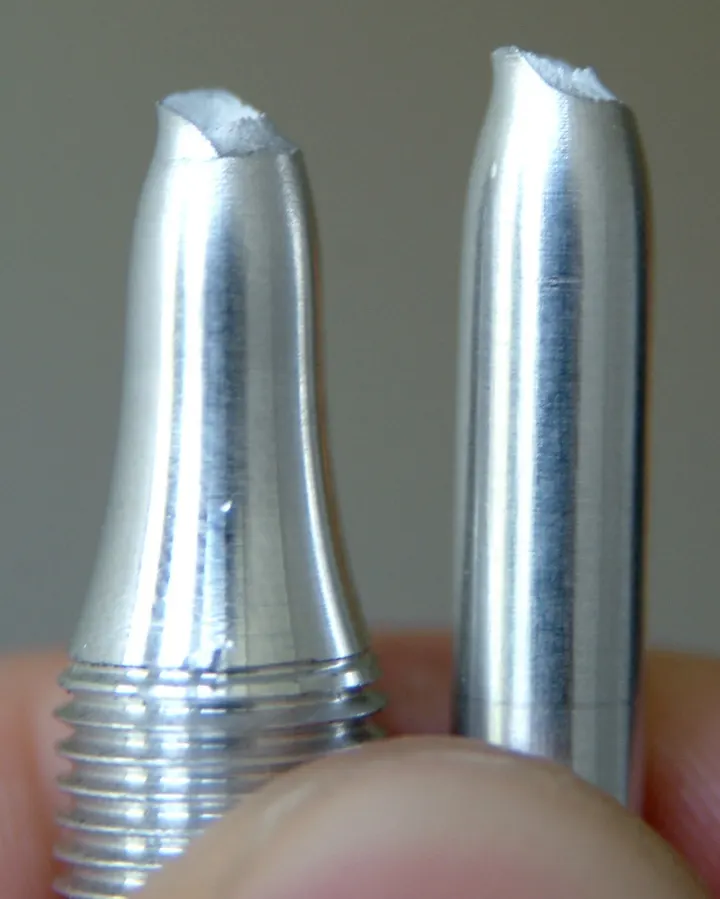
- Necking and fracture. After the UTS, one short length starts to thin faster than the rest: . The force needed falls, so the engineering stress drops, and the bar breaks in the neck.
- Unloading. If you unload from beyond yield, the bar springs back along a line parallel to the first slope. The elastic part recovers; the plastic part stays as permanent set.
The area under the curve is the energy absorbed per unit volume (toughness).
Key formulas
Strain (engineering strain):
Hooke’s law, valid in the linear elastic range only:
Combining with gives the stretch of a uniform bar:
- strain (often quoted as a % or as “microstrain”, με = 10⁻⁶) none
- change in length m
- original length m
- normal stress Pa
- Young’s modulus (about 200 GPa for steel, 69–70 GPa for aluminium alloys) Pa
- axial force and cross-section area N, m²
Worked example
Interactive lab
Stress–strain curve explorer
- Stretch a little and tick “Unload”: in the elastic range the bar springs back to zero strain.
- Stretch past yield and unload: the bar comes back along a line parallel to the first slope and keeps a permanent stretch.
- Compare steel with grey cast iron: similar stiffness at first, but the iron breaks at a tiny strain with almost no warning.
- The shaded area is energy absorbed per cubic metre. Ductile metals absorb far more before breaking.
Engineering stress σ (MPa) against strain ε (%)
- Stress σ
- —
- Region
- —
- Permanent strain if unloaded
- —
- Energy absorbed
- —
- Young’s modulus E
- —
- Yield / tensile strength
- —
Model assumptions and limits
- Idealised engineering stress–strain curves (force ÷ original area, stretch ÷ original length) at room temperature and slow loading.
- Young’s modulus, yield and tensile strength are representative published values; the strain points that shape the curve are illustrative.
- Real curves vary with composition, heat treatment, product form, temperature and loading rate. Do not use these numbers for design.
- After necking starts, engineering stress falls because the original area is used; the true stress in the neck keeps rising.
Where it is used
- Material certificates quote yield strength, UTS and elongation from tensile tests on each batch of steel or aluminium.
- Bolt tightening relies on Hooke’s law: a bolt is a stiff spring, and its stretch sets the clamping force.
- Strain gauges glued to bridges, aircraft wings and load cells measure tiny strains; multiplying by E gives the stress.
- Metal forming (pressing car body panels, drawing wire) deliberately works in the plastic region.
- Crash structures are made of ductile metals that absorb energy by deforming plastically.
Common misconceptions
Self-check
Check A 1.5 m aluminium bar (E = 70 GPa) is stressed to 140 MPa, below its yield strength. How much does it stretch?
Show answer
. .
Check A steel bar is stretched beyond yield and then unloaded. Does it return to its original length?
Show answer
No. It springs back only by the elastic part of the strain, along a line parallel to the original elastic slope. The plastic part remains as permanent set.
Check Two materials have the same yield strength, but one has twice the Young’s modulus. Which stretches more at the same stress below yield?
Show answer
The one with the lower modulus stretches twice as much, because .
My notes
Private to this browser. Select any text above to highlight it.