Heat treatment
How heating and cooling change a steel — annealing, normalising, quenching, tempering, case hardening — and how hardenability is measured.
0 deeper section(s) hidden.
On this page
The idea
Heat treatment changes a metal’s properties without changing its shape, by controlling heating and cooling. For steel, heat into the austenite range, then cool at a chosen rate: slowly for soft, ductile steel (), in air for a finer, stronger structure (), or very fast to trap carbon in hard, brittle (). then trades some hardness for toughness, and hardens only the surface.
Everyday intuition
A blacksmith heats a blade until it glows, plunges it into water to make it hard, then warms it gently so it will not shatter. A paper clip bent back and forth gets harder and then snaps; heating it red-hot and cooling it slowly would soften it again.
How it works
- Austenitise. Heat above the critical temperature (about 727 °C plus a margin) and hold until the temperature is even.
- Annealing. Cool very slowly in the furnace: coarse ferrite and pearlite, soft and easy to machine; also removes work hardening and internal stresses.
- Normalising. Cool in still air: finer grains, a little stronger and tougher.
- Quenching. Cool in seconds in water, brine or oil: martensite, very hard but brittle and stressed.
- Tempering. Reheat to a moderate temperature well below 727 °C: toughness rises, hardness falls. Higher tempering temperature means tougher and softer.
- Case hardening. Add carbon or nitrogen at the surface, or heat only the surface, then quench: hard skin, tough core.
- Will a thick part harden right through? That depends on the steel’s hardenability, measured with the Jominy test described below.
In more detail
Hardenability is the ability of a steel to partially or completely transform from austenite to some fraction of martensite at a given depth below the surface, when cooled under a given condition. For example, a steel of a high hardenability can transform to a high fraction of martensite to depths of several millimetres under relatively slow cooling, such as an oil quench, whereas a steel of low hardenability may only form a high fraction of martensite to a depth of less than a millimetre, even under rapid cooling such as a water quench. Hardenability therefore describes the capacity of the steel to harden in depth under a given set of conditions.
Steels with high hardenability are needed for large high strength components, such as large extruder screws for injection moulding of polymers, pistons for rock breakers, mine shaft supports, aircraft undercarriages, and also for small high precision components such as die-casting moulds, drills and presses for stamping coins. High hardenability allows slower quenches to be used (e.g. oil quench), which reduces the distortion and residual stress from thermal gradients.
Steels with low hardenability may be used for smaller components, such as chisels and shears, or for surface hardened components such as gears.
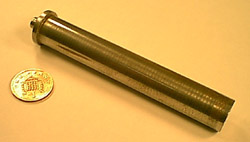
The test sample is a cylinder with a length of 102 mm (4 inches) and a diameter of 25.4 mm (1 inch).
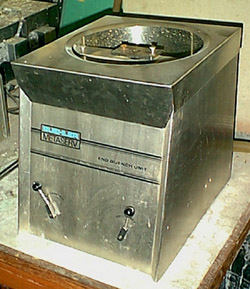
The steel sample is normalised to eliminate differences in microstructure due to previous forging, and then austenitised. This is usually at a temperature of 800 to 900°C. The test sample is quickly transferred to the test machine, where it is held vertically and sprayed with a controlled flow of water onto one end of the sample. This cools the specimen from one end, simulating the effect of quenching a larger steel component in water.
The cooling rate varies along the length of the sample from very rapid at the quenched end, to rates equivalent to air cooling at the other end.
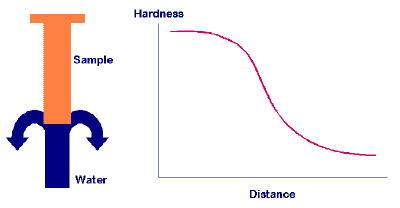
The round specimen is then ground flat along its length to a depth of 0.38 mm (15 thousandths of an inch) to remove decarburised material. The hardness is measured at intervals from the quenched end. The interval is typically 1.5 mm for alloy steels and 0.75 mm for carbon steels.
High hardness occurs where high volume fractions of martensite develop. Lower hardness indicates transformation to bainite or ferrite/pearlite microstructures.
Tempering: reheating a quenched part to a moderate temperature.
Key formulas
Heat to raise a temperature:
- heat J
- mass kg
- specific heat capacity J/(kg·K)
- temperature rise K
Worked example
Where it is used
- Gears, cams and bearings: case hardened for wear-resistant surfaces with tough cores.
- Springs and hand tools: quenched and tempered.
- Sheet and wire: annealed between forming steps so they do not crack.
- Aircraft aluminium alloys: solution treated and aged (precipitation hardening).
Common misconceptions
Self-check
Check A tempered chisel is too brittle. Re-temper at a higher or lower temperature?
Show answer
Higher — tempering hotter gives more toughness and a little less hardness.
Check Why might the centre of a thick quenched bar be softer than its surface?
Show answer
It cools too slowly to form martensite throughout; low-hardenability steels show this most.
Check Which treatment softens cold-worked sheet before pressing it again?
Show answer
Annealing.
My notes
Private to this browser. Select any text above to highlight it.