Module 1 · Engineering mechanics
Momentum and impulse
Momentum is mass times velocity; impulse is force times time. Why airbags and crumple zones work, and how momentum is conserved in collisions.
0 deeper section(s) hidden.
On this page
The idea
is mass times velocity, . It measures how hard something is to stop. Changing momentum takes an : a force acting for a time, . The same change of momentum can come from a big force for a short time or a small force for a long time, which is the whole idea behind airbags, crumple zones and padding. When bodies collide and no outside force acts, the total momentum before equals the total after: .
Everyday intuition
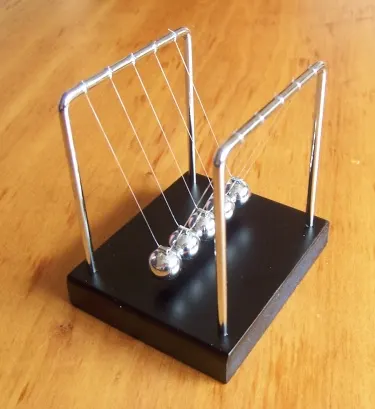
Catching a cricket ball, you pull your hands back: this stretches the stopping time and softens the force on your hands. A loaded lorry at walking pace is harder to stop than a bicycle at the same speed: it has far more momentum. A Newton’s cradle passes momentum along a line of balls.
How it works
- Momentum is a vector. It points the same way as the velocity. Choose a positive direction and give each momentum a sign.
- Newton’s second law in momentum form. Net force = rate of change of momentum. For constant mass this is just F = ma.
- Impulse. Over a short time the force may vary wildly (a hammer blow, a crash). Its total effect is the impulse: the area under the force–time graph, equal to the change in momentum.
- Stretch the time, cut the force. For a fixed change in momentum (say, stopping a car), a longer stopping time means a lower average force.
- Collisions. During a collision the bodies push on each other with equal and opposite forces for the same time (third law), so their momentum changes are equal and opposite. Total momentum stays the same.
- Energy in collisions. Momentum is always conserved in a collision (if no outside force acts), but kinetic energy usually is not: some becomes heat, sound and permanent deformation. A collision that conserves kinetic energy is ; one where the bodies stick together loses the most.
Both areas are equal: the same impulse stops the same momentum.
Key formulas
Momentum, impulse and the impulse–momentum principle:
Conservation of momentum for two bodies (no external force):
Perfectly inelastic collision (bodies stick together):
- momentum kg·m/s
- impulse N·s
- average force N
- time the force acts s
- velocities before and after m/s
- masses kg
Worked example
Where it is used
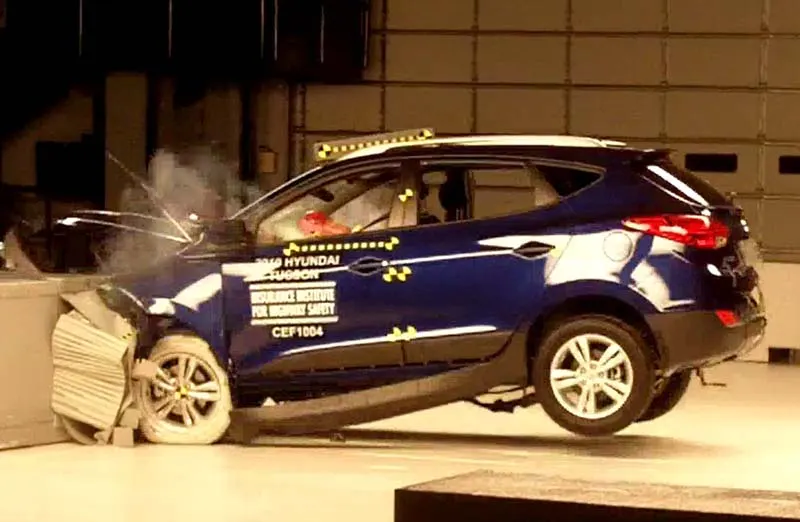
- Vehicle safety: crumple zones, airbags, seat belts and helmets all lengthen stopping time.
- Packaging: foam and air cushions protect goods when dropped.
- Jets, rockets, pumps and turbines: thrust comes from the rate of change of momentum of a fluid (Modules 6 and 13).
- Pile drivers, hammers and presses: delivering a large impulse in a short time (Module 9).
- Guns and recoil: the gun’s backward momentum equals the bullet’s forward momentum.
Common misconceptions
Self-check
Check A 0.16 kg cricket ball at 30 m/s is caught and stopped in 0.05 s. What is the average force on the hands? What if the catch takes 0.2 s?
Show answer
N·s. In 0.05 s: 4.8/0.05 = 96 N. In 0.2 s: 4.8/0.2 = 24 N.
Check A 60 kg skater at rest pushes a 40 kg skater, who moves off at 1.5 m/s. What happens to the first skater?
Show answer
Total momentum starts at zero, so and m/s: they move backwards at 1 m/s.
Check Why does a Newton’s cradle eventually stop swinging?
Show answer
Each collision is not perfectly elastic and there is air drag and friction at the strings, so a little kinetic energy becomes heat and sound each time.
My notes
Private to this browser. Select any text above to highlight it.