Ceramics
Hard, stiff, heat-resistant and brittle — why ceramics behave as they do, from glass and concrete to alumina cutting tools.
0 deeper section(s) hidden.
On this page
The idea
are inorganic, non-metallic solids: oxides such as alumina, carbides, glass, cement and concrete, brick and porcelain. Strong ionic and covalent bonds make them hard, stiff, chemically stable and able to survive high temperatures. The same bonds leave almost no way for atoms to slip, so a ceramic cannot yield to blunt a crack: it is , and much weaker in tension than in compression.
Everyday intuition
A ceramic mug survives boiling water for years but shatters when dropped on tiles. Concrete holds up buildings in compression but cracks when bent, so it is reinforced with steel. Sandpaper uses ceramic grit because it is harder than what it rubs.
How it works
- Flaws control strength. Every ceramic has tiny pores and cracks from manufacture. Under tension, stress concentrates at the worst flaw and, with no yielding, the crack runs.
- Compression closes cracks, so ceramics are far stronger in compression. Concrete is used in compression; steel bars carry the tension.
- Strength is statistical. Identical-looking parts break at scattered loads, and bigger parts tend to be weaker, so designs use statistics and large margins.
- Thermal shock: sudden temperature changes cause uneven expansion and can crack brittle ceramics.
In more detail
Firstly, what is a ceramic? It is difficult to provide a precise definition of a “ceramic” and attempts to do this often end up a little vague. One possible definition is “a solid, inorganic, non-metallic material with an ordered atomic arrangement”. A distinction is usually made between ceramics and inorganic glasses, which have a disordered atomic arrangement. [The problem is that any definition will not fully define the category and will leave fuzzy boundaries. For example, do semiconductors such as silicon fall within the scope of ceramics, with “semiconductor” merely describing a behaviour? As noted by David Richerson, it is more important to understand the materials science relevant to ceramics rather than to get bogged down in the specifics of the category, accepting that pottery, slip cast bathroom sinks, sintered diesel engine filters and so on will rub along together with edge cases that we might care to include.]
A practical way to recognise ceramics is by their shared properties: they are usually stiff, hard and brittle, and often refractory — able to keep their strength at high temperatures.
Typical properties, which all follow from the ionic and/or covalent nature of the bonding, include:
As seen from the Ashby plot of compressive strength against density above, technical ceramics have the highest compressive strengths. Non-technical ceramics also have relatively high compressive strengths ranging from ~30 MPa for concrete to ~100 MPa for more historical building materials such as sandstone and granite. Their high compressive strength, high elastic moduli, and relatively lower densities make these non-technical ceramics ideal for withstanding the weight of buildings.
As seen from the Ashby plot of fracture toughness against density above, ceramics have a lower fracture toughness than most metals and alloys, and some polymers. Ceramics are brittle because their grain boundaries are usually weak and as paths for easy crack propagation.
In contrast to metallic bonding in metals, ceramics are held together by strong covalent or ionic bonds. The atoms are not likely to ‘slide over each other’ so bonds are not easily broken and reformed, which is needed for dislocation movement and subsequent plastic deformation. Thus, ceramics will exhibit very little if any plastic deformation beyond their yield stress before failing. Ceramics can be described as brittle.
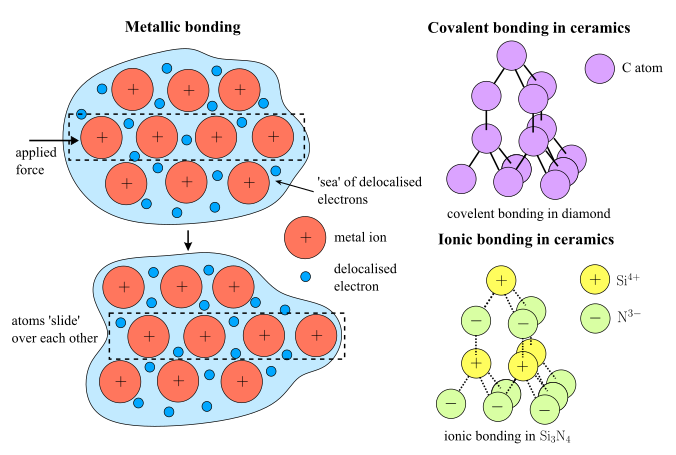
In a metal the material yields locally and blunts the tip.
Key formulas
Elastic strain:
- strain none
- stress Pa
- Young’s modulus Pa
Worked example
Where it is used
- Cutting tools and abrasives: alumina, silicon carbide, cubic boron nitride.
- Furnace linings, spark plugs and turbine coatings: heat resistance and electrical insulation.
- Construction: concrete, brick and glass.
- Bearings and seals: ceramic balls and faces for hardness and wear resistance.
Common misconceptions
Self-check
Check Why is concrete reinforced with steel bars?
Show answer
Concrete is strong in compression but cracks in tension; the steel carries the tension, for example on the underside of a beam.
Check Why do two identical-looking ceramic tiles break at different loads?
Show answer
Each has a different worst flaw, and the biggest, sharpest flaw sets the breaking load.
Check A glass fibre (E = 76 GPa) is stressed to 100 MPa. What is its strain?
Show answer
, about 0.13%.
My notes
Private to this browser. Select any text above to highlight it.